3D Pens for Beginners: How They Work and How to Choose (2026)
A 3D pen lets you draw in the air: it melts a strand of plastic that hardens within seconds, so lines can stand up on their own and become shapes. This page explains how 3D pens work, the difference between low- and high-temperature pens, what to look for as a beginner and which pen suits which age. We have not tested pens ourselves: the information comes from manufacturers and Amazon.com listings.
* Affiliate link. As an Amazon Associate we earn from qualifying purchases, at no extra cost to you. Affiliate disclosure
Key takeaways
- A 3D pen melts plastic and pushes it out of a tip. The plastic cools and hardens almost immediately.
- Low-temperature pens are made for kids: the tip doesn’t get hot enough to burn, but they take special plastic.
- High-temperature pens use standard PLA or ABS filament, give stronger results and suit teens and adults, with care around the hot tip.
- For kids from 6, the best-known choice is the 3Doodler Start+ ($53.82 on Amazon.com, checked Nov 8, 2026).
How a 3D pen works
A 3D pen works like a handheld hot glue gun with a fine tip. You feed a strand of plastic into the back, a motor pushes it forward, a heating element melts it and it comes out of the nozzle as a thin line. Within a few seconds the line cools and becomes solid. That means you can draw flat shapes on paper, lift the pen to draw upward, or join several flat parts into a 3D object.
Most pens have a button to feed plastic, a way to reverse it for color changes, and sometimes speed or temperature settings.
Low- vs. high-temperature pens
| Low-temperature pen | High-temperature pen | |
|---|---|---|
| Who it’s for | Younger kids (often 6+, check the manufacturer) | Teens and adults, or kids with supervision |
| Plastic | Special low-melt plastic, often a pen-specific format (such as 3Doodler Start strands) or PCL | Standard 1.75 mm PLA or ABS filament |
| Tip | Designed not to get hot enough to burn | Gets hot enough to melt PLA or ABS: don’t touch it |
| Results | Softer, more flexible shapes | Stiffer, more durable and more detailed shapes |
| Refills | Fewer choices, often from the pen’s brand | Cheap and widely available |
Check which plastic a pen takes before buying refills: low-temperature plastic doesn’t work in high-temperature pens, and the other way round.
How to choose a 3D pen
- Age of the user: for young kids, a low-temperature pen designed for their age. For teens and adults, a high-temperature pen.
- Refills: how easy and how cheap they are to buy. Pens that take standard 1.75 mm filament have the most choice.
- Controls: a reverse button makes color changes easier. Adjustable speed helps beginners: slower is easier to control.
- Power: cordless (rechargeable) is easier for kids. Corded or USB-powered pens don’t run out mid-project.
- Grip and weight: a light, slim pen is more comfortable for longer sessions and small hands.
- What’s in the box: starter plastic, stencils or an activity guide, and a drawing mat make the first sessions easier.
Our pick for kids: 3Doodler Start+
price checked Nov 8, 2026
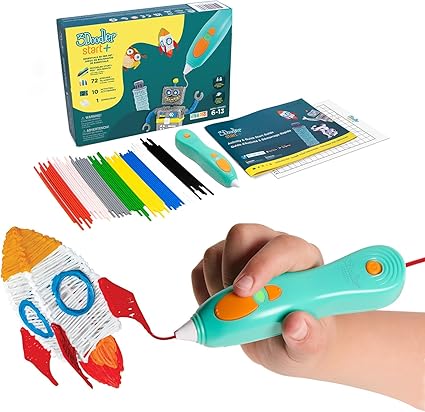
A low-temperature pen designed for children aged 6 and up, with no hot external parts according to 3Doodler. Cordless with USB-C charging, one button and a dedicated reverse button. The Essentials set includes 72 plastic strands and an activity guide with 10 projects. It takes its own Start strands, not standard filament.
View on Amazon* Read the full guideRefills for the Start+ are explained on our page about 3Doodler Start refills: the official 250-strand bag costs $31.01 on Amazon.com.
We are checking high-temperature pens for teens and adults on Amazon.com and will add them here with current prices.
What you can make
- Flat shapes from stencils: trace a template, let it cool and peel it off. The easiest way to start.
- 3D objects from flat parts: draw the sides of a cube, a house or an animal flat, then join them with lines of plastic.
- Decoration: names, ornaments, small figures and gift tags.
- Repairs and touch-ups: with a high-temperature pen, filling small gaps or fixing 3D prints.
Short projects work best at first: one color, a simple outline, then fill it in.
3D pen or 3D printer?
A 3D pen is a drawing tool: everything is made by hand, so results depend on your skill and are never perfectly precise. A 3D printer builds objects automatically from a digital model, with repeatable, accurate results, but costs much more and needs software. A pen is a good, inexpensive way for kids to get into 3D shapes. If you want to make functional parts or detailed models, start with our 3D printing guide or our best 3D printers for beginners.
Safety and age
- Follow the manufacturer’s age recommendation, and supervise young children, as with any electrical toy.
- High-temperature pens have a hot metal tip: keep fingers away and put the pen in its stand when not drawing.
- Work in a ventilated room, especially with ABS, which smells stronger than PLA.
- Use the plastic the pen is made for: the wrong plastic can jam the pen or overheat.
FAQ
What is the best 3D pen for beginners?
It depends on age. For kids from 6, a low-temperature pen like the 3Doodler Start+ is designed to be safe to hold. Teens and adults usually get better results with a high-temperature pen that takes standard PLA or ABS filament and has adjustable speed.
What age is a 3D pen for?
Low-temperature pens for kids are usually recommended from 6 years by their manufacturers. High-temperature pens get hot at the tip and are generally aimed at older kids with supervision, teens and adults. Always check the manufacturer’s recommendation.
What filament does a 3D pen use?
Most high-temperature pens use 1.75 mm PLA or ABS filament. Low-temperature pens use special low-melt plastic, sometimes in their own format: the 3Doodler Start, for example, only takes Start strands.
Is a 3D pen the same as a 3D printer?
No. A 3D pen is held and moved by hand like a pen, so you draw every line yourself. A 3D printer builds objects automatically from a digital file.