Bambu Lab A1 Mini Review (2026): Specs, Price and Who It’s For
How this review was made
- We have not tested this printer ourselves. This is a research-based review: manufacturer specifications, the Amazon.com listing and published hands-on reviews by independent outlets, which we link below.
- Where a point comes from a third party, we say who reported it.
The Bambu Lab A1 Mini is our pick as the best 3D printer for most beginners. It calibrates itself, runs quietly and is ready to print soon after unboxing. Its one big limit is size: the build volume is 180 mm (about 7 inches) on each side.
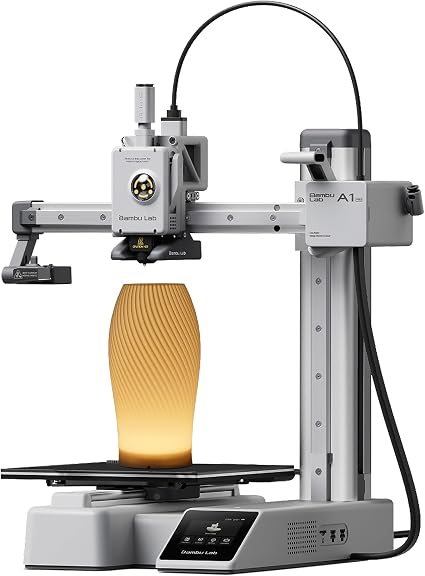
Listed on Amazon.com with an LED lamp kit. The AMS lite color unit is not included: the A1 Mini Combo bundles it.
View on Amazon** Affiliate link. As an Amazon Associate we earn from qualifying purchases, at no extra cost to you.
Specs at a glance
| Spec | Bambu Lab A1 Mini |
|---|---|
| Price on Amazon.com | $249 (checked Nov 7, 2026) |
| Build volume | 180 × 180 × 180 mm |
| Design | Open frame, moving bed (“bed slinger”) |
| Calibration | Fully automatic, with active flow rate compensation |
| Speed | Up to 500 mm/s, 10,000 mm/s² acceleration (manufacturer) |
| Noise | 48 dB or less in silent mode (manufacturer) |
| Multicolor | Optional with the AMS lite (up to 4 colors) |
| Recommended materials | PLA, PETG, TPU, PVA |
| Connectivity | Wi-Fi, Bambu Handy app, Bambu Studio slicer |
What Bambu Lab promises
Bambu Lab sells the A1 Mini as a printer for people who don’t want to tinker. It levels the bed, sets the nozzle height and tunes vibration compensation on its own, and a sensor in the toolhead adjusts the filament flow while printing. Models can be sent from the MakerWorld library or the phone app, and the nozzle can be swapped without tools. It is the smaller sibling of the Bambu Lab A1, with the same software and the same calibration, a smaller bed and a lower price.
What published reviews report
- Ease of use: Tom’s Hardware calls it fast, quiet and easy to use, and notes that it levels itself completely, using the nozzle as the probe. All3DP praises the self-calibration and the beginner-friendly experience.
- Build quality: TechRadar highlights the all-metal rails and linear bearings, which make the frame rigid for a printer this small.
- Materials: All3DP sees it as best suited to PLA and PETG. With an open frame, ABS and ASA are not what it is made for.
- Size: the most common limit in reviews is the 180 mm build volume. Large helmets, cosplay parts or long boxes won’t fit in one piece.
Who should buy the A1 Mini?
Beginners who want a printer that works without fiddling, for small and medium objects: key chains, desk organizers, plant pots, miniatures, replacement parts, gifts. Our list of first 3D printing projects fits this build volume well.
Who should look elsewhere
- You want larger prints: the Bambu Lab A1 has a 256 mm build volume with the same ease of use.
- You want ABS or ASA: an enclosed printer such as the Bambu Lab P1S or the Creality K1C.
- You want to spend as little as possible: the Creality Ender-3 V3 SE costs $199 but needs more setup.
Our verdict
Based on the specifications and on what independent reviewers report, the A1 Mini is one of the easiest ways into 3D printing at $249. Buy it if your projects fit in a 7-inch cube. If you are unsure, the larger A1 costs more but removes the size question.
FAQ
Is the Bambu Lab A1 Mini good for beginners?
Yes, that is what it was designed for: fully automatic calibration, an app to start prints and a large library of ready-made models. Reviewers consistently describe it as easy to use.
Is the A1 Mini build volume big enough?
For most household objects, yes. At 180 × 180 × 180 mm it is too small for large single-piece prints such as helmets. If you plan large prints, choose the A1 with 256 mm.
Can the A1 Mini print in multiple colors?
Yes, with the optional AMS lite, which feeds up to four spools. It is sold separately or as the A1 Mini Combo.
Was the A1 Mini part of the A1 recall?
No. The 2024 heatbed cable recall concerned the larger A1, not the A1 Mini.